Top 12 Traits

of High-Performing Truckload Carriers

Chris Henry  ·  President  ·  KSM Transport Advisors

September 22, 2025

The 12 Traits

What separates the carriers who thrive from those who merely survive? After analyzing hundreds of truckload operations, we've identified 12 common traits.

1

Transparency & Financial Literacy

2

Delegation & Empowerment

3

Centralized Pricing Model

4

Network Discipline

5

Power Lanes vs. Spider Lanes

6

FreightMath — Network Profitability

7

Strength of Weak Ties

8

Data Sanity

9

Courage to Shrink

10

Maintenance Excellence

11

Safety Pays Dividends

12

Legacy-Focused & Humble Leadership

Transparency & Financial Literacy

  • Transparency builds trust — the foundation of every high-performing organization
  • Combined with financial literacy, it enables better decision-making at every level
  • Makes it easier to identify high-performing talent and reward accordingly
  • Creates a culture of entrepreneurialism — everyone thinks like an owner
  • Collaboration between finance and operations drives profitability
Survey Question
Out of $1.00 of Revenue, how much is left over after all expenses?

If a team member thinks you're making 62% net margins, do you think they're really contemplating the cost impact of their day-to-day decisions?

Click to reveal →

Delegation & Empowerment Before Action

01

Free Up Leadership

Effective delegation frees management for strategic initiatives — working on the business instead of in it

02

Foster Innovation

Empowering employees drives engagement, accountability, and innovation from the ground up

03

Train & Communicate

Clear communication and training are essential — delegation without support is abandonment

04

Measure & Trust

Empowerment balanced with performance metrics creates confident, effective decision-makers

Click to reveal next step

Centralized Pricing Model

🔗
Link to Trait #1

To price freight, you need to know your costs — all of them — if you want to be profitable.

Think like an actuary, not a salesperson.

  • Executive-level pricing ownership — not left to individual contributors
  • Consistent discounts and upcharges applied across the entire organization
  • Centralization enables better cost control and profitability analysis
  • Utilize internal and external data to optimize pricing decisions
  • Regularly review and adjust strategies for maximum profitability

The Result

Less 'finger-pointing' between sales and operations. Everyone works from the same pricing foundation, with a clear understanding of cost and margin targets.

🚀 Coming Spring 2026

Click to learn about a new precision pricing tool

Network Discipline — The Art of Saying 'No'

Stop chasing the largest vanity metric in trucking — truck count. Stop saying "I have to keep my drivers moving."

DENSITY

Builds Efficiency

More loads in fewer markets = less deadhead, better utilization

EFFICIENCY

Builds Velocity

Higher utilization = faster turns, more revenue per truck per week

VELOCITY

Builds Profitability

Can't just evaluate freight based on rate per mile — network density is the multiplier

Network Discipline — The Art of Saying 'No'

Power Lanes vs. Spider Lanes

🟢 Power Lanes = More Profit

Most freight dense lanes. Top 25% by load count. Do more here.

🔴 Spider Lanes = More Loss

Least freight dense lanes. Bottom 25%. Begin to cut.

Define Your Network and Stick With It!

The 5-Step Exercise

1
Stratify lanes using a standardized market model — count loads origin → destination (e.g. 14-week window)
2
Rank from most dense to least dense
3
Bottom 25% = Spider Lanes
4
Top 25% = Power Lanes
5
Grow Power Lanes, eliminate Spider Lanes
Click to reveal next step

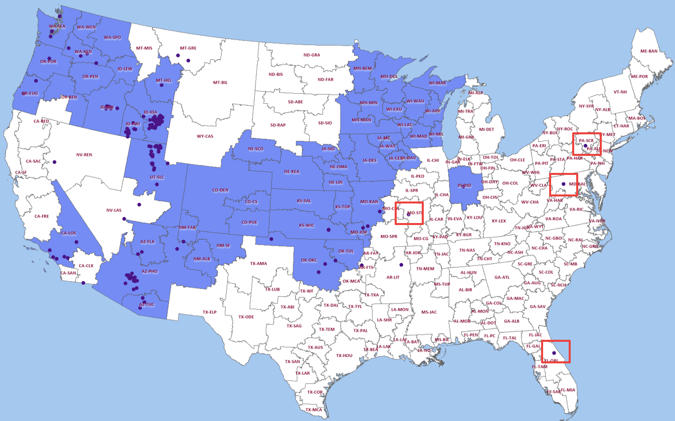
The 'Hidden Cost' of Out-of-Network Drivers

Day 1 — Broker Load

Eastern WA → MO. 124 mi DH. 1,908 LOH @ $2.40 all-in. Margin: $210. Transit: 5d 7h.

Day 5–12 — Sitting & Deadheading

DH 50 mi home. Sits 7 days. DH 315 mi to KS → Amarillo. 545 LOH. Margin: $332. Transit: 2d 7h.

Expanded Study — 5 Carriers (140–410 Tractors)

72% of bottom-quartile yield drivers lived outside the network. Out-of-network drivers reduce velocity and dilute the footprint.

Total Time
14+
Days
Total Revenue
$4,723
Two Loads
Total Margin
$542
vs. Client Avg $1,227
Net Profitability
-$98
After Fixed Costs
Measuring Network Profitability

① Core OR
One-way profitability of each load. Revenue & costs from origin to destination including transit time, loaded/deadhead miles, tolls, and overhead.
Load OR: 94.2%
② Inbound OR
Average OR of all loads and empties into the origin market. How profitable is it to get to the pickup?
IB OR: 98.7%
③ Outbound OR
Average OR of all loads and empties out of the destination market. What happens after delivery?
OB OR: 103.1%
④ FreightMath OR
Combines Core + IB + OB to measure each load's true network fit and contribution to overall profitability.
FM OR: 97.4%
Empty
Loaded

Strength of Weak Ties

Backhaul is Outdated

One company's backhaul is another company's headhaul (unless you're based in Florida). Think network value, not one-way profitability.

Broker as Connector

Proper use of brokers allows carriers to efficiently connect good market areas to other good market areas. Can't just evaluate on RPM.

Network vs. One-Way

A load that looks marginal on a one-way basis may be highly profitable when you measure its full network contribution via FreightMath OR.

Data Sanity

Data Sanity > Data Vanity

  • MUST continuously question the accuracy of your data
  • Reliable data as a foundation — a significant issue among most TL carriers
  • Build a Data Dictionary — define every metric consistently
  • Audit current KPIs: what is actionable (sanity) vs. not (vanity)

KPI Focus

Re-define KPIs aligned with business goals. Focus on 3–5 organization-wide and 1–2 per department. Then rinse and repeat regularly.

Mapping KPI Success

DEFINE

Identify Metrics

3–5 org-wide KPIs aligned to profitability

AUDIT

Sanity Check

Is each KPI actionable? Kill vanity metrics.

REPEAT

Iterate

Review quarterly. Adjust as the business evolves.

The Courage to Shrink

  • The most difficult trait — truck count is a misguided indicator of performance
  • As the market erodes, the magnifying glass increases. Set a Minimum Margin Threshold
  • Shrinking might mean parking trucks — often more advantageous than running at a loss
  • Importance of brokerage/non-asset to maintain customer relationships while right-sizing
The Hard Truth
Stop chasing the largest vanity metric in trucking — truck count

Stop saying "I have to keep my drivers moving." A smaller, more profitable fleet beats a larger money-losing one every time.

Maintenance Excellence

The Deepest Hole in Trucking

  • Mechanically-inclined operators have a massive competitive advantage
  • Benchmark relentlessly. Adopt "Stances" — SOPs + the Why
  • Be relentless on inventory management
Total Maintenance Cost/Mile (Dryvan)
$0.14
$0.40+
Including Labor — Massive Variance

Safety Pays Dividends

  • Top carriers have notably lower insurance costs — you can't get there without making safety a key objective
  • Accidents erase profits. Severe accidents can erase a decade's profits
  • High incidence rates erode profits in slower, steady increments
  • Safety is essential for sustainable growth and societal well-being
The Bottom Line
Safety isn't a cost center — it's a profit center

Invest in safety culture, technology, and training. The ROI is measurable in lower insurance premiums, fewer claims, and sustained profitability.

Legacy-Focused & Humble Leadership

Legacy Focus

Understand their importance to the community. Foster continuous learning. Build lasting relationships.

Collaboration

Open communication drives innovative problem-solving and cross-functional partnerships.

Humility

Approachable leadership improves morale. Inclusive decision-making leads to better strategies.

Resilience

They've been through down-cycles. They prioritize sustainability and long-term viability.

Questions?

The carriers who embrace these 12 traits will be the ones standing when the cycle turns.

📧

Get in Touch

[email protected]

📰

FreightMath News

All 12 Traits in your inbox. Tips, best practices & education — not marketing.

🚀

Free Trial

30-Day Complimentary FreightMath Trial

FreightMath by KSM

www.freightmath.com  ·  www.ksmta.com

to navigate